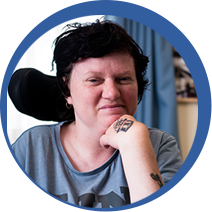
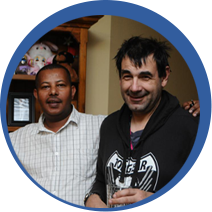
Gellibrand team member Helene Rouault says there are some big differences between disability supports in France and Australia.
Gellibrand team member Helene Rouault has lived in Australia since 2011, but she was still a student in France when she first supported people with disability. She did some holiday work at a respite accommodation facility in Switzerland and realised straightaway how much she enjoyed working in the sector.
“It was a very good experience, a very good foundation,” Helene says, adding that her only other experience of people with disability before Gellibrand was spending time with her cousin back in France. “She has autism – and I watched my auntie and uncle fight for her rights.”
By 2009, Helene had moved from her home in France to work as a graphic designer in Spain. Then the economic downturn hit and she found herself unemployed – for two years.
“I decided to go very far away from that,” she says, adding that she made a choice between Canada and Australia, with the southern land coming out the winner. She learnt English, was employed in hospitality in Melbourne for several years, and worked her way up to becoming a café manager. Then COVID and lockdowns arrived and Helene’s employment prospects once again took a dive.
“I thought, ‘What industry can I go into where I will never lose my job again?’”
She remembered how much she had enjoyed her work with disabled people in Switzerland and decided to study for a Certificate IV in Disability Support as Melbourne’s lockdowns rolled on. She did her work placement at Gellibrand, applied for a role during a recruitment drive, and now here she is.
“I am just working at two houses,” she says, “and you create a bond with clients, which is good. You can understand their needs, even if they don’t communicate like you and I.”
Helene says, even though she hasn’t lived in France for more than a decade, that disability support is different here compared to her home country.
“It is better here to be honest. We are known for good social stuff in France, but we are not doing well in the disability sector.”
Helene says people with disability in France can rarely obtain shared accommodation and there remains a strong emphasis on institutionalisation.
“The institutions are very understaffed; the work isn’t very well paid compared to here. Support is more focussed on the clients in Australia. When there are institutions, you can’t provide one to one support.”
Helene says multiculturalism is one of Gellibrand’s greatest strengths. Though she hasn’t worked with any French or Spanish speaking clients (Helene is fluent in both languages), she says Gellibrand’s capacity to create relationships between clients and team members from the same cultural backgrounds is helpful. She also says team members who are recent immigrants to Australia are often at an advantage when it comes to working in the sector.
“They have been through challenges in their lives and they’ve needed to be flexible, especially to move to a new country and learn a new language. Working in the disability sector, you have to be flexible.”
When Helene works with clients, she sometimes puts to use her graphic design and illustration skills. While that might be colouring in with some clients, others take the opportunity with her to expand their artistic range.
“They just need motivation sometimes,” she says. “Kate is someone who sometimes does sessions doing freestyle art. And Tin can be very creative when you support him to focus on his art works.”